Stand on a paved street at 2 p.m. in June, then step under a large tree. The air feels different within seconds: cooler, softer, calmer. That small moment is a preview of what trees do for whole cities, rivers, farms and the planet.
Trees are easy to take for granted because they work quietly and slowly. But they cool our streets, soak up floodwater, hold soil in place, clean the air, store carbon and give a home to most of the land animals on Earth. This guide explains what trees actually do, how they do it, and what you can do to help.
The big picture
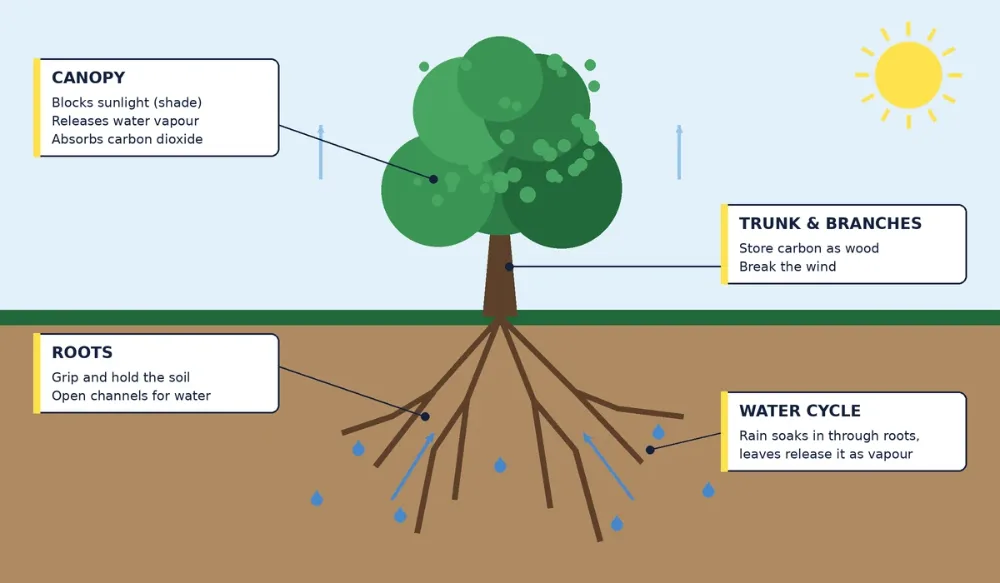
A tree is a living machine with three main parts, and each one does a different job for the world around it.
| Part of the tree | What it does | What we get |
|---|---|---|
| Leaves and canopy | Block sunlight, release water vapour, catch rain and dust, absorb carbon dioxide | Shade, cooler air, cleaner air, slower rainfall |
| Trunk and branches | Store carbon as wood, break the wind | Long-term carbon storage, shelter |
| Roots | Grip soil, open channels underground, pull water from the ground | Less erosion, less runoff, steadier water supply |
Numbers in this guide are typical ranges. Real results depend on the species, the age of the tree, the climate and the soil.
How trees cool the air
Trees cool their surroundings in two different ways, and they work together.
1. Shade
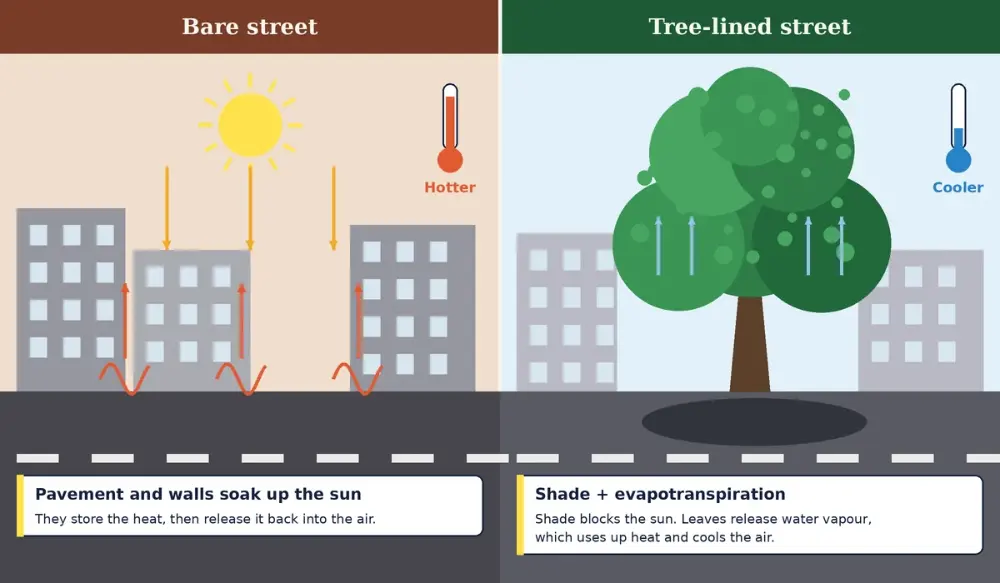
Roads, roofs and walls soak up sunlight and turn it into heat. A tree canopy blocks much of that sunlight before it arrives. Surfaces in the shade can stay many degrees cooler than the same surface in full sun, and on a hot afternoon the difference can be large. A shaded wall or car park also gives off less heat into the air around it.
2. Evapotranspiration (sweating, in plain words)
A tree pulls water up from the soil through its roots and releases it as vapour through tiny pores in its leaves. Turning liquid water into vapour uses up heat energy, the same reason sweat cools your skin. The tree is, in effect, a natural air conditioner that runs on sunlight and groundwater.
The urban heat island: cities are often several degrees hotter than the countryside around them, because concrete, asphalt and dark roofs store heat while there is little vegetation to cool the air. Planting trees is one of the most effective ways to reduce this, which is why many city governments now set targets for tree cover.
The cooling matters for health as well as comfort. Heat waves are dangerous for older people, young children and outdoor workers. Cooler streets mean lower hospital admissions on the worst days, and lower electricity use, because buildings shaded by trees need less air conditioning.
How trees reduce floods
When heavy rain falls on bare, hard ground, nearly all of it runs straight off into drains, streams and rivers, all at once. Trees change that in four steps.
- The canopy catches rain. Leaves and branches hold some water on their surfaces, and part of it evaporates without ever reaching the ground. The rest drips down slowly instead of hammering the soil.
- Roots open up the soil. Roots and the life around them (worms, fungi, insects) create small channels. Forest soil is spongy and takes in water far faster than compacted or paved ground.
- The soil stores water. The water that soaks in is held in the ground and released slowly into streams over days and weeks. This is why forested catchments often keep flowing in dry periods.
- Trees pump water back out. Through their leaves, trees return soaked-up water to the air, which dries the soil out again so it can absorb the next rain.
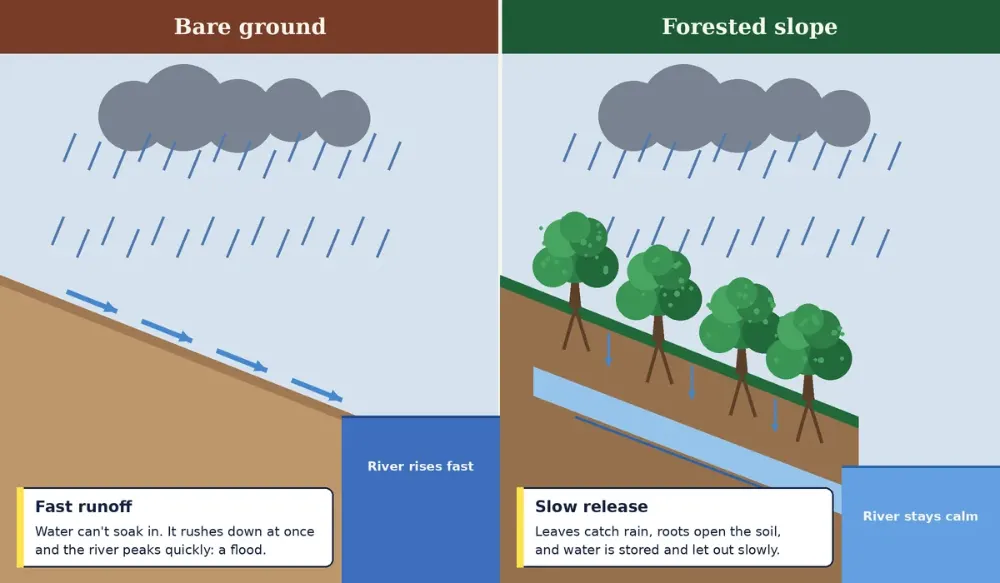
The effect is not just about the amount of water but about timing. A flood happens when too much water reaches a river at the same moment. Trees spread that water out over a longer time, which lowers the peak and gives people more time to react.
An honest limit: trees help most in small and medium storms. In an extreme downpour, or when the soil is already full from days of rain, even a healthy forest cannot absorb everything. Trees are one layer of flood protection, alongside good drainage, embankments, and keeping homes out of flood plains. They are not a replacement for these.
Floods in cities
In cities, rain lands on roofs and roads and rushes into drains that can only carry so much. Street trees, parks, and planted strips beside roads give the water somewhere to go, and take pressure off the drainage system. Trees planted along riverbanks also help, because their roots hold the banks together so they wash away less in high water.
Soil, landslides and water supply
Soil is what grows our food, and it is lost faster than it forms. A single heavy rain can wash away the top layer of an unprotected field.
- Against erosion: roots bind soil particles together, and leaf litter on the ground protects the surface from the force of raindrops.
- Against landslides: on steep slopes, deep roots act like anchors that tie loose soil to firmer layers below. Cut the trees and the slope becomes much more likely to slide in heavy rain.
- Against dust and desertification: rows of trees (shelterbelts) slow the wind, so less topsoil blows away from farmland.
- For clean water: forest soil filters rainwater as it passes through, so streams from forested land often carry less mud and fewer pollutants. Many cities get their drinking water from forested catchments for this reason.
- For groundwater: water that soaks in under trees helps refill underground stores that wells and farms depend on.
Clean air and carbon
Carbon dioxide
Trees take carbon dioxide from the air to make food by photosynthesis, and they keep the carbon in their wood, roots and soil. Burning fossil fuels adds carbon dioxide to the air, and forests are one of the main natural ways it gets taken back out. A single mature tree is often estimated to absorb in the region of 20 kilograms of carbon dioxide a year, though this varies a lot with species, size and climate.
Old trees matter most. A big, long-lived tree stores far more carbon than a seedling, and it keeps it for decades or centuries. Protecting existing forests is usually a faster and surer way to hold carbon than replanting after they are gone.
Dust and pollution
Leaf surfaces catch fine dust and soot from the air, and rain then washes it to the ground. Trees also absorb some polluting gases through their leaves. A line of trees between a busy road and a house will not remove all pollution, but it helps, and it also blocks some noise.
Oxygen: a common myth
Trees do release oxygen, but the idea that forests are "the lungs of the planet" is overstated. Plants also use oxygen at night and when their leaves and wood decay, and most of the oxygen in the air built up over a very long time. The real urgent reasons to protect forests are carbon, water, climate and wildlife.
Trees and rainfall
Forests do not only react to the weather; they help make it. Water that trees release from their leaves rises into the air and later falls again as rain, often downwind. In large forests such as the Amazon, a big share of the rain comes from moisture that the forest itself recycled. Clear a very large area and the region can become drier, which in turn makes it harder for the forest to recover.
On a smaller scale, belts of trees around fields slow hot, dry winds, which protects crops and reduces the water they lose.
Homes for wildlife
Forests cover only part of the land but are home to most of the land-based plant and animal species, including a large share of birds, mammals and amphibians. A single old tree can support hundreds of species: birds nest in it, insects live in the bark, fungi grow in the dead wood, and mammals shelter in the hollows.
Many of these animals do work for us as well. Bees and other insects pollinate crops, birds eat pests, and bats spread seeds. When trees go, these free services go too.
Trees and people
- Mental health: studies keep finding that time near trees lowers stress and improves mood, and people living on green streets tend to report better wellbeing.
- Food and income: fruit, nuts, timber, fuel, fodder and medicine all come from trees, and millions of people depend on forests for their living.
- Safer streets and calmer traffic: tree-lined roads feel narrower, so drivers tend to slow down, and shade makes walking and cycling more pleasant.
- Property and business: homes and shops on green streets often hold their value better, and people spend more time in shaded shopping areas.
- Lower bills: shade on the sunny side of a building cuts the need for cooling, and a windbreak can reduce heating in cold regions.
What happens when we lose trees
Every benefit above can run in reverse. Cutting forests, clearing land, and paving over green space tends to bring the same set of problems together.
| When trees are removed | What tends to follow |
|---|---|
| Shade and evapotranspiration disappear | Hotter streets, hotter villages, higher cooling costs |
| Soil loses roots and cover | Faster runoff, bigger flood peaks, muddy rivers |
| Slopes lose their anchors | More erosion and landslides |
| Stored carbon is released | More carbon dioxide in the air, faster climate change |
| Habitat is cut up or destroyed | Wildlife decline and loss of pollination and pest control |
| Local moisture recycling drops | Drier local climate in some regions |
Around the world, forests have been shrinking for a long time, and tens of millions of hectares of forest are cleared or degraded over a few years. The pace has slowed in some places and sped up in others, so the exact figure depends on the year and how it is counted. The direction of the problem is clear enough: we are losing trees faster than we are growing them back in many regions.
What you can do
Plant the right tree in the right place
- Choose native or well-adapted species. They need less water, resist local pests, and feed local wildlife.
- Check the space. Look up, down and sideways before planting: power lines, pipes, building foundations and how wide the tree will grow in 20 years.
- Mix species. A mixed planting survives disease and drought better than rows of one kind.
Keep it alive
Planting is the easy part. The first two or three years decide whether a young tree lives, so water it during dry spells, protect it from grazing animals, keep weeds from crowding it, and mulch the soil around it. A tree that dies after planting gives nothing back, so a few well-cared-for trees beat a hundred forgotten ones.
Protect the trees you already have
- Avoid cutting mature trees when a building or road can be adjusted instead.
- Do not pile soil, concrete or heavy machinery over the root zone.
- Support local rules and community groups that protect green spaces and forests.
Think bigger than your own garden
- Join a community planting day or a neighbourhood tree-care group.
- Ask your school, workplace and local council about shade and tree-planting plans.
- Choose paper, wood and food products from sources that do not drive deforestation.
A note on tree-planting drives: big planting campaigns are only useful if the trees survive and suit the place. Planting a single species in the wrong landscape, or in natural grassland where trees do not belong, can do harm. Quality, species choice and long-term care matter more than the headline number.
The 2-minute self-check
- Look at your street or yard. How much of the ground is shaded at noon?
- After the next heavy rain, watch where the water goes. Does it soak in, or rush off?
- Count the mature trees near your home. Are any of them at risk?
- Find one spot where a tree could safely go, and note how much space it will need when grown.
- Check whether your local council or a community group runs a planting or care programme.
The short checklist
- Trees cool the air through shade and evapotranspiration
- Canopy and roots slow rainwater, which lowers flood peaks (but not in every extreme storm)
- Roots hold soil, protect slopes and help clean and store water
- Trees store carbon, and old trees store the most
- Forests help create rainfall and shelter most land wildlife
- Protect existing trees first, then plant native species in suitable places
- Water and protect young trees for the first few years
- Judge any planting project by how many trees survive, not how many are planted
A tree is one of the few things we can plant today that keeps giving for generations: shade for your children, floodwater held back for your neighbours, and a cooler, steadier world for everyone downstream. The best time to plant one was twenty years ago. The second best time is this season.